
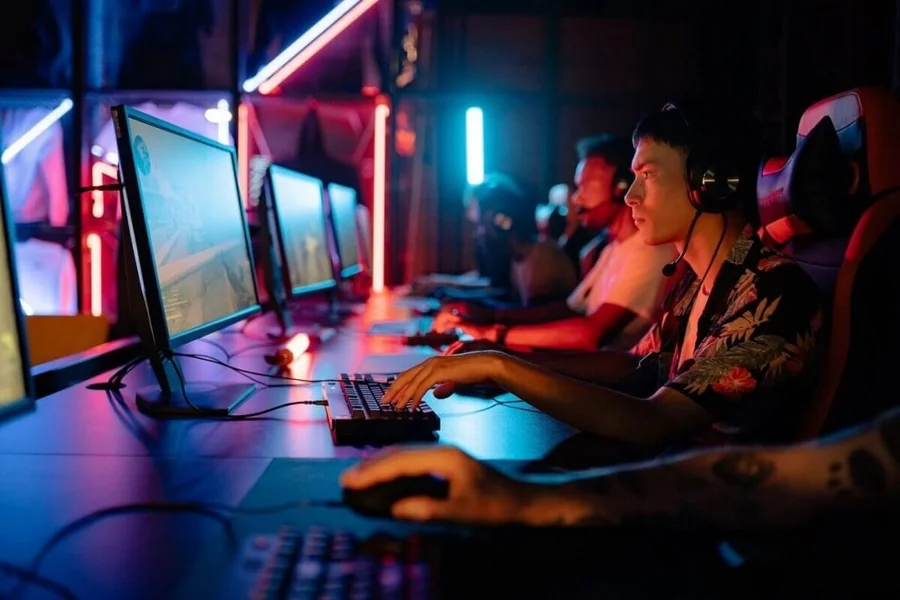
Online gaming has been developed over the years. What started as mere, informal games through dial-up internet connections, is now a multi-billion-dollar business sector, providing an experience as informative as a lighthearted pastime, to something as intense as international competitive esports. The evolution of online Slot gacor since its initial inception up to the present form of the game has been more of a transition into the world of technology, evolving player demands and an ever professionalized landscape.
The Early Days: Casual Gaming
The initial momentum through online gaming was in the 1990s when the internet was more accessible. The very idea of playing the video games with the people all over the world, was a new one and the earliest online games were rather basic. The multiplayer games such as Doom (1993) and Warcraft (1994) enabled them to connect through the local area networks (LAN) and early internet, though they were still nowhere the experiences we have today.
Online gaming during this period was a leisure activity to most of the players. It did not have any professional teams, sponsorships, or international tournaments. Players were logging in due to the pure excitement of playing against other people, but were in most cases restricted by technology during that era. The dial-up internet connection was considered slow and prone to failure and the graphics of the early online games were very primitive.
The Emergence of the Massively Multiplayer Online Games
The end of 1990s and the beginning of 2000s experienced a serious change in the situation on the Internet in the context of the online games. With the introduction of massively multiplayer online games (MMOs) like EverQuest (1999) and World of Warcraft (2004) there was a new sense of immersion and social interaction. These games enabled the player to venture into large virtual worlds, meet with thousands of other players and organize guilds or teams to overcome the challenges.
Social elements of playing were also put into focus by MMOs and contributed greatly towards increased and more varied player base. These games were not only about playing, but about forming relationships, establishing communities and collectively driving towards the realization of shared objectives. The casual gamers were happy to log in and see their friends, play missions, as well as read new content, and the hardcore gamers had an opportunity to immerse themselves in the gameplay, enhance their characters and their abilities.
With the emergence of MMOs, online gaming became a popular pastime activity, with millions of players worldwide. Nevertheless, even with the huge numbers of players, MMOs were still casual, and many players were satisfied playing on their own pace without the feeling that they were forced to play to win and achieve the highest ranks.
The Migration to Competitive Gaming
Although the world of casual Slot was booming, a few players, who were fully devoted to gaming, started pushing the limits of what can be done with online gaming. Technology brought about an improvement in competitive games that are multi player and also made them more complex and faster. Such titles as StarCraft (1998) and Quake III Arena (1999) started to establish the competitive gaming genre with skill-based, fast-paced play, which demanded greater concentration, accuracy and tactical thinking.
At the beginning of the 2000s, the idea of competitive gaming began to take shape. LAN parties, in which gamers could assemble in large numbers to challenge each other in person became more popular. Tournaments were held to play such games as Counter-Strike (1999) and Warcraft III (2002), but with relatively small cash prizes, and the scene was still quite small. Players were largely amateurs and they played to love the game and the event was more of showing personal talent more than to earn a livelihood through gaming.
Esports Professionalization
With the rise of the broadband internet connections and the development of the game design, online gaming has become more sophisticated. The competitive gaming had begun to receive the recognition it was due towards the mid 2000s. This was particularly evident in the emergence of esports which is a term that can be used to refer to organized multiplayer video game competitions. Esports started to receive sponsorships, media coverage, and a fan following, and gaming has become a valid entertainment and competition.
The release of such games as League of Legends (2009) and Dota 2 (2013) initiated the new phase of competitive games. These were highly strategic and complex games that were best played at esports competition. The result of their success was the formation of professional leagues and tournaments, like The International of Dota 2 and the League of Legends World Championship with multi-million-dollar prize pools.
Esports is not a phenomenon that existed in a vacuum; it expanded globally in a very short time. The largest esports tournaments started to attract tens of thousands of live viewers, and millions of people were viewing online broadcasts with the help of such services as Twitch and YouTube. This change to professional structured competitions increased online gaming to a level of being compared to traditional sports.
Streaming and the Development of Gaming as a Career
The development of esports was also accompanied by the gaming streams. As a result, platforms such as Twitch that started in 2011 enabled gamers to stream their gameplay to an international audience. Previously, streamers were just amateur gamers that could gather audiences and earn money with the help of subscriptions, donations and sponsorships. Gaming streaming made several gamers become full-time content creators, which further professionalized the industry.
Not only has streaming provided players with a chance to earn a living through playing games but it has also made online gaming mainstream. This is because viewers could now view their favorite players in real time and they had access to high level of gameplay and strategies that were once exclusive to professional leagues. The availability of streaming also served to bring new players to the competitive gaming who wanted to study how to be the best and in some way or other, they could someday have their own contribution in the world of esport.
Mobile Gaming and Competitive Play Democratization
Mobile slot have been growing at an incendiary rate in the last ten years, bringing the competitive gaming to a new population segment. Mobile games, such as Clash Royale (2016), PUBG Mobile (2018), and Free Fire (2017), have gained massively popular with the advent of smartphones, especially in such places as Southeast Asia and Latin America. Competitive gaming has become more affordable with the introduction of these games, and players who might not own a high-end gaming PC or a gaming console have an inexpensive entry point to the sport.
Mobile esports tournaments too have been on the upward trend with some even garnering big cash prizes and international followings. The competitive gaming has been democratized whereby any player regardless of his or her social status can now take part in high stakes competition without leaving the comforts of their homes.
The Future of Online Gaming
Online gaming has a bright future, as new technologies such as 5G, cloud gaming, and virtual reality (VR) can transform the sphere and make the gaming process easier and more realistic, whereas cloud-based gaming services, such as Google Stadia and Xbox Cloud Gaming, will enable people to stream games without having to invest in costly hardware. Also, the introduction of the VR technology will potentially raise the gaming experiences to the next level with the fully engulfed worlds and realistic mechanisms of the gameplay that will blur the borders between the virtual and the real.
With the ever-changing nature of competitive gaming, the boundary between casual and competitive gaming is becoming more unclear. Competitive features are being introduced into more and more games, ranked modes and tournaments have become a staple component of most games. Whether it is playing to have fun or pursuing career in gaming, the development of online gaming has provided a game where all players regardless of their ability can be found.
Conclusion
It is a tribute to gamers and game developers alike that the online gaming industry has evolved in such a large, competitive business that we recognize today. Online gaming has unlimited possibilities as technology keeps improving. The evolution of the esports, the emergence of streaming, and the availability of mobile gaming have made the gaming industry richer and livelier. And with the industry still growing, it is not even possible to guess what the next chapter of online gaming will entail.